Showing posts with label drawing. Show all posts
Showing posts with label drawing. Show all posts

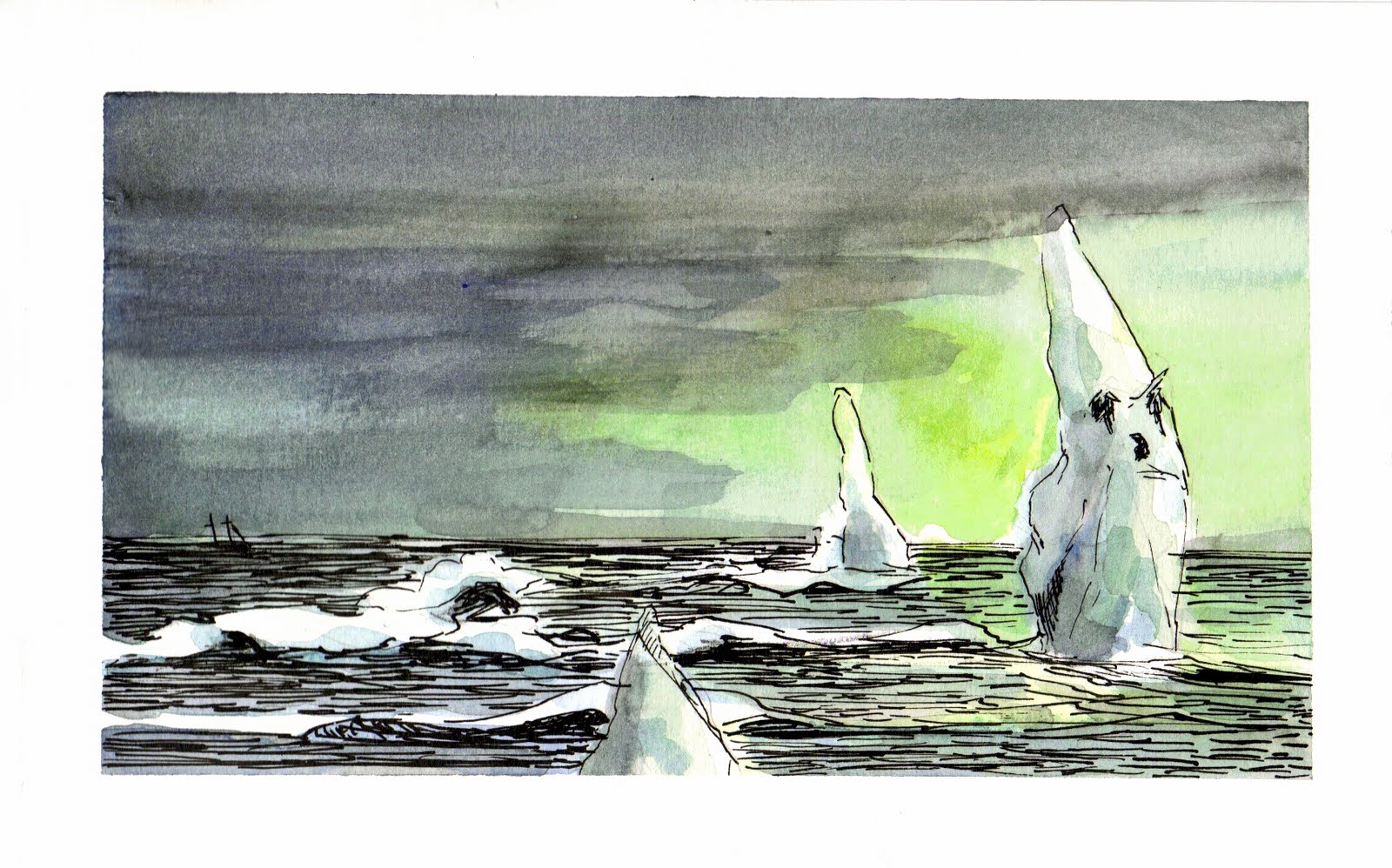


Kunst. My kunst. What am I hoping to do with my big dirty kunst? That is a question I keep asking myself. It has been three months of thinking, pondering, daydreaming about where I would push a new project to. Some call it waiting for inspiration, I think I was more in the research mode myself. But who's to say?
I still veer towards the arctic imagery, but been trying to add to it or change it more. I tried bringing the mountains in to the work, as a sense of place is part of my work. They just don't click to me, I can attach no personal connection to them.
I've been interested in the Polaris Expedition, specifically where some of the crew get stranded on an ice floe for six months, drifting in the Arctic. I don't want to illustrate this, like scene for scene, that is too easy and it has already been done. So what do I extrapolate from this narrative story? There is this sense of adventure, desperation, survival, violence, schism, isolation, etc. All these things engage me. There is the idea of history painting, but that always has a basis in the real world - a current issue. I think that falls short for me as well.
I'm drifting like the people on the ice floe here. That feels like the best connection from me to them right there.
O.K. Lets get down to the nitty gritty there, maybe it can lead to better understanding of what I want to do idea wise. Physically I want to do a series of works of prints and drawings - small and large scale, and sculpture work.
This is going nowhere. Garbage

"It is the bareness of drawing that I like. The act of drawing is what locates, suggests, discovers."
Philip Guston, 1913 - 1980
A update of my whereabouts lately:
Been workin at Easter Edge Gallery, trying to get the 24H.A.M up and on the roll.
Printing when I can get off my lazy arse at St. Michael's Printshop. Currently in the process of editioning an etching, one of my rocket images. Not sure what the edition number will be, 13 or 15 seems a good number, currently on number 5.
I've had a lithograph hanging round as well, needing to be printed. Got to get that it printed soon, so I can get on to another one. Have a few ideas churning. The edition number will that will probably be the same as above.
Been currently debating the idea of editioning as well. Not sure if I like the justification of it. Editioning is for primarily economic concerns really, all goes back to it, ensuring its limited and rare, can ask for more money. So really unsure if I agree with it, goes againest some marxist tendacies of mine.
Drawing as well, some rockets and a new project. The new project deals with using the history and imagery of the North Pole Explorers. Manliplating history, maps, imagery, text, etc to reflect my own personal exploration. Inspired by Jane Urqharts book "The Underpainter", a quote found in it.
Besides that, I have another project in mind, which I will be writing a NLAC proposal for. Hopefully I get it, would be really swell. Probably will be hammering out the idea a bit on here. Send it to my homies, get their opinion on it.
Also reading Terry Eagleton's "After Theory", which is a realy interesting read. That will be followed by some Zizek.
Outside of that, I do waste a lot of time napping like a fiend in the heat, watching Seinfeld, surfing the internet way too long. Like now. Identified that I have a addiction to caffine, particularly coke. Got headaches from now having it all day.
Anyway, that's it.
Been workin at Easter Edge Gallery, trying to get the 24H.A.M up and on the roll.
Printing when I can get off my lazy arse at St. Michael's Printshop. Currently in the process of editioning an etching, one of my rocket images. Not sure what the edition number will be, 13 or 15 seems a good number, currently on number 5.
I've had a lithograph hanging round as well, needing to be printed. Got to get that it printed soon, so I can get on to another one. Have a few ideas churning. The edition number will that will probably be the same as above.
Been currently debating the idea of editioning as well. Not sure if I like the justification of it. Editioning is for primarily economic concerns really, all goes back to it, ensuring its limited and rare, can ask for more money. So really unsure if I agree with it, goes againest some marxist tendacies of mine.
Drawing as well, some rockets and a new project. The new project deals with using the history and imagery of the North Pole Explorers. Manliplating history, maps, imagery, text, etc to reflect my own personal exploration. Inspired by Jane Urqharts book "The Underpainter", a quote found in it.
Besides that, I have another project in mind, which I will be writing a NLAC proposal for. Hopefully I get it, would be really swell. Probably will be hammering out the idea a bit on here. Send it to my homies, get their opinion on it.
Also reading Terry Eagleton's "After Theory", which is a realy interesting read. That will be followed by some Zizek.
Outside of that, I do waste a lot of time napping like a fiend in the heat, watching Seinfeld, surfing the internet way too long. Like now. Identified that I have a addiction to caffine, particularly coke. Got headaches from now having it all day.
Anyway, that's it.
And sometime around 2 AM you end up taking advantage of yourself.
Posted by Jona8than | Labels: art, drawing, in progress, life, quote, reading | Posted On Friday, May 9, 2008 at 2:11 a.m.
"And sometime around 2 AM you end up taking advantage of yourself. Ain't no way around that. Making a scene with a magazine."
Tom Waits, Nighthawks at the Diner 1975
And sometimes around 2 weeks you end up taking advantage of yourself and others. Ain't no way around that. making a scene with an art magazine
It's 2am, I'll probably be up for another two hours, if not more. Been reading Ralph Steadman's The Joke's Over, a book about him and his relationship as artist to Hunter S. Thompson, and Nietzsche's Beyond Good and Evil. Two madman perhaps. Also been reading the latest Border Crossing, a Canadian art magazine, fuck, been reading all the copies I have of Border Crossing. Looking for something, finding tons of things, I have everything really; some talent and skill, a decent enough mind, paper, supplies, even some ideas and sketches for Goya's sake, no distractions of girls or drinkin' distractions [though I'd love a little bit of both...], and the only things against that are few. Lack of space and no courage.
And I do have a lack of space, I don't have the grandiose space of the fourth year space in school. I got a wall in the bedroom for drawing and a small space out in the shed for painting or wood. The weather affects the shed, and it has been miserable. The room wall works though.
I just don't have the courage to draw or make art here. I have before, the summer past, but for some reason I don't want to do stuff in front of the folks. Have always been private around them, but as my art gets more introspective at times, I don't want to explain it to them. Shit, I don't want to explain anything. Isn't that lame? The being inside all day does not help either, this cabin fever. And without that courage to explain, or least lie, I can't draw. Can't draw without courage, won't be art, be demoralizing to use Nietzsche even. Would bring about the downturn or further downturn of humanity. It's an unfortunate excuse, but it the excuse.
Have all this talk about changing my ways in the previous post, but am I? I don't sleep at night because when I lie down, with nothing distracting, all the baggage enters, all the questions and worries.
Listening to Kanye helps, but not enough.

Tom Waits, Nighthawks at the Diner 1975
And sometimes around 2 weeks you end up taking advantage of yourself and others. Ain't no way around that. making a scene with an art magazine
It's 2am, I'll probably be up for another two hours, if not more. Been reading Ralph Steadman's The Joke's Over, a book about him and his relationship as artist to Hunter S. Thompson, and Nietzsche's Beyond Good and Evil. Two madman perhaps. Also been reading the latest Border Crossing, a Canadian art magazine, fuck, been reading all the copies I have of Border Crossing. Looking for something, finding tons of things, I have everything really; some talent and skill, a decent enough mind, paper, supplies, even some ideas and sketches for Goya's sake, no distractions of girls or drinkin' distractions [though I'd love a little bit of both...], and the only things against that are few. Lack of space and no courage.
And I do have a lack of space, I don't have the grandiose space of the fourth year space in school. I got a wall in the bedroom for drawing and a small space out in the shed for painting or wood. The weather affects the shed, and it has been miserable. The room wall works though.
I just don't have the courage to draw or make art here. I have before, the summer past, but for some reason I don't want to do stuff in front of the folks. Have always been private around them, but as my art gets more introspective at times, I don't want to explain it to them. Shit, I don't want to explain anything. Isn't that lame? The being inside all day does not help either, this cabin fever. And without that courage to explain, or least lie, I can't draw. Can't draw without courage, won't be art, be demoralizing to use Nietzsche even. Would bring about the downturn or further downturn of humanity. It's an unfortunate excuse, but it the excuse.
Have all this talk about changing my ways in the previous post, but am I? I don't sleep at night because when I lie down, with nothing distracting, all the baggage enters, all the questions and worries.
Listening to Kanye helps, but not enough.
A quote
Posted by Jona8than | Labels: drawing, quote, research | Posted On Tuesday, March 25, 2008 at 12:06 a.m.
"Painting and drawing seem to me to be too closely related to the subconscious, to something that goes beyond reason. This scares me, perhaps I would say too much about myself..."
Christian Boltanski, page 136
Boltanski
Fourth Year Paper 2.1
Posted by Jona8than | Labels: art, drawing, essay, in progress, paper, reading, Work, writing | Posted On Monday, March 24, 2008 at 4:39 p.m.
Still needs some more revising...
My work deals with the ideas of death and loss, through the use of objects, space, and narrative. I use objects that have contain small memories and history to them, and by placing them in created and often neutral spaces, to convey the larger ideas of mortality and loss. I use the medium of drawing, for it can show the sensitively and vulnerabilities of being human. It is like a slow motion version of thought, for the process of drawing can be imprecise, and uncertain. Drawing captures this by the power of it being an unmediated impression of the artists hand and mark on the surface.
My research is very intuitive and habitual, a part of my daily routine. My research is engaged in areas of art, philosophy, gender issues, sexuality, sociology, literature and an increased interest in thanatology. Death and loss factor in my research in ideas dealing with how mortality and death are dealt with in western cultures, as in issues of confronting and overcoming. Ideas on desire and death have also become an idea of note as of late, the idea that death and desire are linked.
These drawings are a continuation of the drawings from last semester, albeit indirectly, a refocusing on the topics at hand. They led me through my research to a passage from Bill Viola
“I want to go to a place that’s seems like it’s at the end of the world. A vantage point from which one can stand and peer out in to the void—the world beyond…there is nothing to lean on. No references…
You finally realize that the void is yourself. It is like some huge mirror for your mind. Clear and uncluttered, it is the opposite of our urban distractive spaces. Out here, the unbound mind can run free. Imagination reigns. Space becomes a projection screen. Inside becomes outside. You can see what you are.”
This was an inspiration point for these drawings, to use the paper as a huge mirror for my mind. The emptiness of the paper would focus the attention on the objects, and create the mood associated with the idea.
The drawings are a collection of objects, and I am extrapolating from Christian Boltanski’s idea of ‘small memory’. For Christian Boltanski ‘small memory’, is memory about little things; trivia, jokes, memories about the little things in life. [ I’ll get the exact quote for this and footnote] The objects in these drawings have memory, but only about small things, small events. These objects however can be used, with their small memories to create larger meaning and ideas through the drawings of them.
The tie clip is a response to an event in my life; the drawing brings the words meditated passion to mind. I choose this specific object because it had personal meaning to me, but I felt it could communicate to others as well by drawing it. I drew this object existing in a neutral space, an empty space, as well as the other drawings. Luc Tuymans and Toba Khedoori both use large amounts of space in their works to a feeling of isolation and emptiness in their works, Khedoori in particular uses it to create a sense of placeless-ness and acute sense of isolation. The neutral space in my drawings work the same way, however they are not totally devoid of a referent like Khedoori’s or to an extent Tuymans, my drawings have a horizon line as a indicator of space and distance.
The tie clip is an object with social and cultural meaning to it, it is an object of restraint but yet also one of flourish. The ability of restraint is also seen as part of the flourish, the ability to restrain one’s self. The ties with its phallic connections play in to this.
Drawn in a realistic manner, from life, and surrounded it by a large mass of charcoal, the item has been marked with tape so it would not interfere with the drawing of the clip. The clip is surrounded with this greyness, to create a surface around the clip that is indeterminate and imposing, to equate it with death. The tie clip exists without the tie, so there is loss and inability to function. The desire for sex is often equated for the desire of death, for death holds the promise of release from desire.
The finger trap drawing is that of a finger trap in the empty or neutral space, hovering in the space and the drawing is split through the middle by the seam of the paper. Perspective and the horizon lines exist in the top of the drawing.
This object of the finger trap is a trick device, where you are trapped by your fingers, and when you try to haul or pull yourself out of, you only get more trapped, the trap tightens. The only way out is to push further in, and let go. The finger trap is made of pieces of bamboo, braided together; bamboo is often seen as a symbol of longevity as well as the twisting and twining in of braiding. The finger trap is a joke, not intended as a restraining device or such, but rather to be an example that one must think differently to escape a situation.
The split in this drawing is to change the perception of the drawing, an interruption of the braid, the linking of the finger trap. To escape the finger trap, one must push their fingers to the centre. If the finger trap is split in the drawing, can one escape when there is no centre to push to? Is one really trapped? So by giving the split, one can see the finger trap as complete or not.
The drawing of the hammer head is drawn in the upper half of the sheet, to place it close to the horizon line and give it a good expense of space.
The hammer head is a found object, was found with no handle. In a way it is decapitated, and remain useless. The head is still good, but it needs a new body, handle to work. I invested it with small, localized narrative through the use of the shadow; the shadow alludes to the missing handle, like the shadow of the handle had been burned in to the image, still there. The hammer head is scratched, and pitted from the activity of work. It is not the shiny new hammer of a store, but one with a history. By the look of the hammer, the lack of the handle and the shadow, along with its position on its side, all work to give the impression of the hammer head being dead.
The horizon line is included in all of the drawings, dividing the empty space up and giving ideas of distance and space. However this is all relative, for the space could be essentially a table top or a soccer field, there is nothing in the drawing to give accurate scale. This relates back to the Bill Viola quote stated above. The horizon line is also used for its placement of the vanishing points, which indicate where all things must go. An idea of Nietzsche also figures in to my including of the horizon line.
My work deals with the ideas of death and loss, through the use of objects, space, and narrative. I use objects that have contain small memories and history to them, and by placing them in created and often neutral spaces, to convey the larger ideas of mortality and loss. I use the medium of drawing, for it can show the sensitively and vulnerabilities of being human. It is like a slow motion version of thought, for the process of drawing can be imprecise, and uncertain. Drawing captures this by the power of it being an unmediated impression of the artists hand and mark on the surface.
My research is very intuitive and habitual, a part of my daily routine. My research is engaged in areas of art, philosophy, gender issues, sexuality, sociology, literature and an increased interest in thanatology. Death and loss factor in my research in ideas dealing with how mortality and death are dealt with in western cultures, as in issues of confronting and overcoming. Ideas on desire and death have also become an idea of note as of late, the idea that death and desire are linked.
These drawings are a continuation of the drawings from last semester, albeit indirectly, a refocusing on the topics at hand. They led me through my research to a passage from Bill Viola
“I want to go to a place that’s seems like it’s at the end of the world. A vantage point from which one can stand and peer out in to the void—the world beyond…there is nothing to lean on. No references…
You finally realize that the void is yourself. It is like some huge mirror for your mind. Clear and uncluttered, it is the opposite of our urban distractive spaces. Out here, the unbound mind can run free. Imagination reigns. Space becomes a projection screen. Inside becomes outside. You can see what you are.”
This was an inspiration point for these drawings, to use the paper as a huge mirror for my mind. The emptiness of the paper would focus the attention on the objects, and create the mood associated with the idea.
The drawings are a collection of objects, and I am extrapolating from Christian Boltanski’s idea of ‘small memory’. For Christian Boltanski ‘small memory’, is memory about little things; trivia, jokes, memories about the little things in life. [ I’ll get the exact quote for this and footnote] The objects in these drawings have memory, but only about small things, small events. These objects however can be used, with their small memories to create larger meaning and ideas through the drawings of them.
The tie clip is a response to an event in my life; the drawing brings the words meditated passion to mind. I choose this specific object because it had personal meaning to me, but I felt it could communicate to others as well by drawing it. I drew this object existing in a neutral space, an empty space, as well as the other drawings. Luc Tuymans and Toba Khedoori both use large amounts of space in their works to a feeling of isolation and emptiness in their works, Khedoori in particular uses it to create a sense of placeless-ness and acute sense of isolation. The neutral space in my drawings work the same way, however they are not totally devoid of a referent like Khedoori’s or to an extent Tuymans, my drawings have a horizon line as a indicator of space and distance.
The tie clip is an object with social and cultural meaning to it, it is an object of restraint but yet also one of flourish. The ability of restraint is also seen as part of the flourish, the ability to restrain one’s self. The ties with its phallic connections play in to this.
Drawn in a realistic manner, from life, and surrounded it by a large mass of charcoal, the item has been marked with tape so it would not interfere with the drawing of the clip. The clip is surrounded with this greyness, to create a surface around the clip that is indeterminate and imposing, to equate it with death. The tie clip exists without the tie, so there is loss and inability to function. The desire for sex is often equated for the desire of death, for death holds the promise of release from desire.
The finger trap drawing is that of a finger trap in the empty or neutral space, hovering in the space and the drawing is split through the middle by the seam of the paper. Perspective and the horizon lines exist in the top of the drawing.
This object of the finger trap is a trick device, where you are trapped by your fingers, and when you try to haul or pull yourself out of, you only get more trapped, the trap tightens. The only way out is to push further in, and let go. The finger trap is made of pieces of bamboo, braided together; bamboo is often seen as a symbol of longevity as well as the twisting and twining in of braiding. The finger trap is a joke, not intended as a restraining device or such, but rather to be an example that one must think differently to escape a situation.
The split in this drawing is to change the perception of the drawing, an interruption of the braid, the linking of the finger trap. To escape the finger trap, one must push their fingers to the centre. If the finger trap is split in the drawing, can one escape when there is no centre to push to? Is one really trapped? So by giving the split, one can see the finger trap as complete or not.
The drawing of the hammer head is drawn in the upper half of the sheet, to place it close to the horizon line and give it a good expense of space.
The hammer head is a found object, was found with no handle. In a way it is decapitated, and remain useless. The head is still good, but it needs a new body, handle to work. I invested it with small, localized narrative through the use of the shadow; the shadow alludes to the missing handle, like the shadow of the handle had been burned in to the image, still there. The hammer head is scratched, and pitted from the activity of work. It is not the shiny new hammer of a store, but one with a history. By the look of the hammer, the lack of the handle and the shadow, along with its position on its side, all work to give the impression of the hammer head being dead.
The horizon line is included in all of the drawings, dividing the empty space up and giving ideas of distance and space. However this is all relative, for the space could be essentially a table top or a soccer field, there is nothing in the drawing to give accurate scale. This relates back to the Bill Viola quote stated above. The horizon line is also used for its placement of the vanishing points, which indicate where all things must go. An idea of Nietzsche also figures in to my including of the horizon line.
while sitting in a coffeehaus
Posted by Jona8than | Labels: drawing, Lucien Freud, painting, Peter Doig, Work, writing | Posted On Sunday, November 11, 2007 at 10:04 p.m.
The week has been an interesting one, busy and distractions galore.
I have been painting, drawing, reading, and obviously not writing...
Thursday I was sitting in Brewed Awakening with Jordan, just after he got off work and I spent money on unnecessary things. Enjoying a hot chocolate [ best hot chocolate in Newfoundland is found there] and perusing a Taschen "Art Now" book. In it the artist Peter Doig is featured; a Scottish/Canadian/Trindad artist, who is known for this interesting landscapes. I am not a huge fan of his work, they don't do it for me, or at least the reproductions don't.
He did say this "I don't think of my paintings as being at all realistic. I think of them as being derived more from within the head than from what's out there in front of you."
It is not one of those wonderful epigrams that can be debated endlessly, but struck a chord with me, for obviously my paintings have a sense of reality to them, but they are definitely more from my head. I will say they are not surrealist, but rather constructed to fit certain subject matter and formal considerations.
I think at times, or rather, in honesty the majority of the time, terribly conscious of the subject matter. In that I think about what I am painting, what is is suppose to be, suppose to look like, I never get to the surface, to just the surface. Lucien Freud said "Mustn't be indulged to the subject matter. I'm so conscious that that is a recipe for bad art"
I think from that I understand why my drawings are seen as more confident, more stronger than my other work. In my drawings, the imagery matters to me, but doesn't control the drawings. The drawings is just done, to be a good drawing. I use the line more easily, tones, everything is just done.
Painting seems different for some reason. Despite my experience with painting, I can not get the same execution of my drawings in it. There is some block there. I have been changing my painting process more, to mixing up large quantities of paint, working more wet on wet, using paint stick, etc. Something just isn't clicking yet. Maybe I have to bust out a lot more paintings. Smaller perhaps, and lots of them?
I have been painting, drawing, reading, and obviously not writing...
Thursday I was sitting in Brewed Awakening with Jordan, just after he got off work and I spent money on unnecessary things. Enjoying a hot chocolate [ best hot chocolate in Newfoundland is found there] and perusing a Taschen "Art Now" book. In it the artist Peter Doig is featured; a Scottish/Canadian/Trindad artist, who is known for this interesting landscapes. I am not a huge fan of his work, they don't do it for me, or at least the reproductions don't.
He did say this "I don't think of my paintings as being at all realistic. I think of them as being derived more from within the head than from what's out there in front of you."
It is not one of those wonderful epigrams that can be debated endlessly, but struck a chord with me, for obviously my paintings have a sense of reality to them, but they are definitely more from my head. I will say they are not surrealist, but rather constructed to fit certain subject matter and formal considerations.
I think at times, or rather, in honesty the majority of the time, terribly conscious of the subject matter. In that I think about what I am painting, what is is suppose to be, suppose to look like, I never get to the surface, to just the surface. Lucien Freud said "Mustn't be indulged to the subject matter. I'm so conscious that that is a recipe for bad art"
I think from that I understand why my drawings are seen as more confident, more stronger than my other work. In my drawings, the imagery matters to me, but doesn't control the drawings. The drawings is just done, to be a good drawing. I use the line more easily, tones, everything is just done.
Painting seems different for some reason. Despite my experience with painting, I can not get the same execution of my drawings in it. There is some block there. I have been changing my painting process more, to mixing up large quantities of paint, working more wet on wet, using paint stick, etc. Something just isn't clicking yet. Maybe I have to bust out a lot more paintings. Smaller perhaps, and lots of them?
It is an interesting question to ask what are your influences in art, it is a question asked I suppose to find out more about your art through comparison of your influences. Of course, your influences change over time, as your range of other artists and their works expand. When writing about ones influences, one always mentions the artists that have had a positive influence on your art. Do not the art that you hate also make an influence on you? As in "I hope to never make something like that". I wonder if that does not have the biggest effect on me, for there is a lot of crap out there I don't want to replicate.
To describe my materials in one word, the word would be "simple". The materials are chosen for their simplicity, and the small sensuality that I enjoy in them.
My drawings are graphite or charcoal on paper; usually graphite for the smoothness of the line, and the shine of the graphite. Charcoal is never forgotten though, the mat black is used sparingly. I always stick to black or grey tones, there is no colour in my media choice. The support has so far always been paper, a few in particular, but I do go through a range. I prefer smooth paper, I find it works best with my adding and subtracting, and usually whites, sometimes BFK cream or grey if feeling especially jolly. That is the extent though, I like the purity of black marks on white. The starkness perhaps.
The drawings are usually large, least a full sheet of paper, sometimes multiple sheets connected, or a large sheet; the expanse of space is enjoyed. I work in an additive/subtractive method, of using the eraser as a drawing tool as much as the pencil.
The paintings are on stretched canvas, though wood is not ruled out. Gessoed, sanded, and toned. Oil paint is what I use, with other media sometimes used like pencil, oil stick, spray paint. I would not call myself a mixed media painter though, does not seem a need to make that distinction. The palette range is very different than my drawings, the palette seems endless, pastel to neon to earths and darks. I am unsure of the distinction between the drawings and painting in terms of colour range as of yet.
The painting do start off usually as a sketch, drawn and redrawn till it feels right compositionally. Then it is drawn on the canvas, freehand, the grid doe not hold any appeal to me. Then light washes, undercoats and darks are applied, sometimes glazed, usually alla prima; due to time constraints.I have been introducing other mark making ways in to my painting, but still always feels like an oil painting to me.
The intaglio etchings are of an average size to myself, though some may consider them large. They are similar to the drawing in that there is an absence of colour, and the support is white, again that starkness. Created either on zinc or copper plate, not a big difference to me except in some technical factors.
They are created using the full range of intaglio techniques, and while printmaking is definitely more process based, they do not differ to me too much from my drawings. They seem of the same sort.
The subject matter, sources and influence, need some more time to digest.
Write some more later.
My drawings are graphite or charcoal on paper; usually graphite for the smoothness of the line, and the shine of the graphite. Charcoal is never forgotten though, the mat black is used sparingly. I always stick to black or grey tones, there is no colour in my media choice. The support has so far always been paper, a few in particular, but I do go through a range. I prefer smooth paper, I find it works best with my adding and subtracting, and usually whites, sometimes BFK cream or grey if feeling especially jolly. That is the extent though, I like the purity of black marks on white. The starkness perhaps.
The drawings are usually large, least a full sheet of paper, sometimes multiple sheets connected, or a large sheet; the expanse of space is enjoyed. I work in an additive/subtractive method, of using the eraser as a drawing tool as much as the pencil.
The paintings are on stretched canvas, though wood is not ruled out. Gessoed, sanded, and toned. Oil paint is what I use, with other media sometimes used like pencil, oil stick, spray paint. I would not call myself a mixed media painter though, does not seem a need to make that distinction. The palette range is very different than my drawings, the palette seems endless, pastel to neon to earths and darks. I am unsure of the distinction between the drawings and painting in terms of colour range as of yet.
The painting do start off usually as a sketch, drawn and redrawn till it feels right compositionally. Then it is drawn on the canvas, freehand, the grid doe not hold any appeal to me. Then light washes, undercoats and darks are applied, sometimes glazed, usually alla prima; due to time constraints.I have been introducing other mark making ways in to my painting, but still always feels like an oil painting to me.
The intaglio etchings are of an average size to myself, though some may consider them large. They are similar to the drawing in that there is an absence of colour, and the support is white, again that starkness. Created either on zinc or copper plate, not a big difference to me except in some technical factors.
They are created using the full range of intaglio techniques, and while printmaking is definitely more process based, they do not differ to me too much from my drawings. They seem of the same sort.
The subject matter, sources and influence, need some more time to digest.
Write some more later.
Subscribe to:
Posts (Atom)